Algae is a natural part of a healthy aquarium, and a small amount is rarely cause for concern. When one organism begins taking over, however, it can indicate an imbalance involving lighting, nutrients, organic waste, water movement, plant health, filtration, or biological maturity.
Correct identification should always come before treatment.
Not everything that looks like algae is actually algae. Cyanobacteria are bacteria, while diatoms and dinoflagellates are very different microscopic organisms that may require completely different approaches.
Before Treating an Algae Problem
Start with the basics:
- Identify the organism as accurately as possible.
- Test your aquarium water.
- Check lighting duration and intensity.
- Remove accumulated detritus.
- Review feeding and stocking levels.
- Check filtration and water movement.
- Manually remove as much nuisance growth as practical.
- Correct the underlying cause rather than only treating the visible growth.
Algaecides and other treatments can sometimes be useful, but killing visible growth without correcting the conditions that allowed it to dominate often results in the problem returning.
Need Help Identifying It?
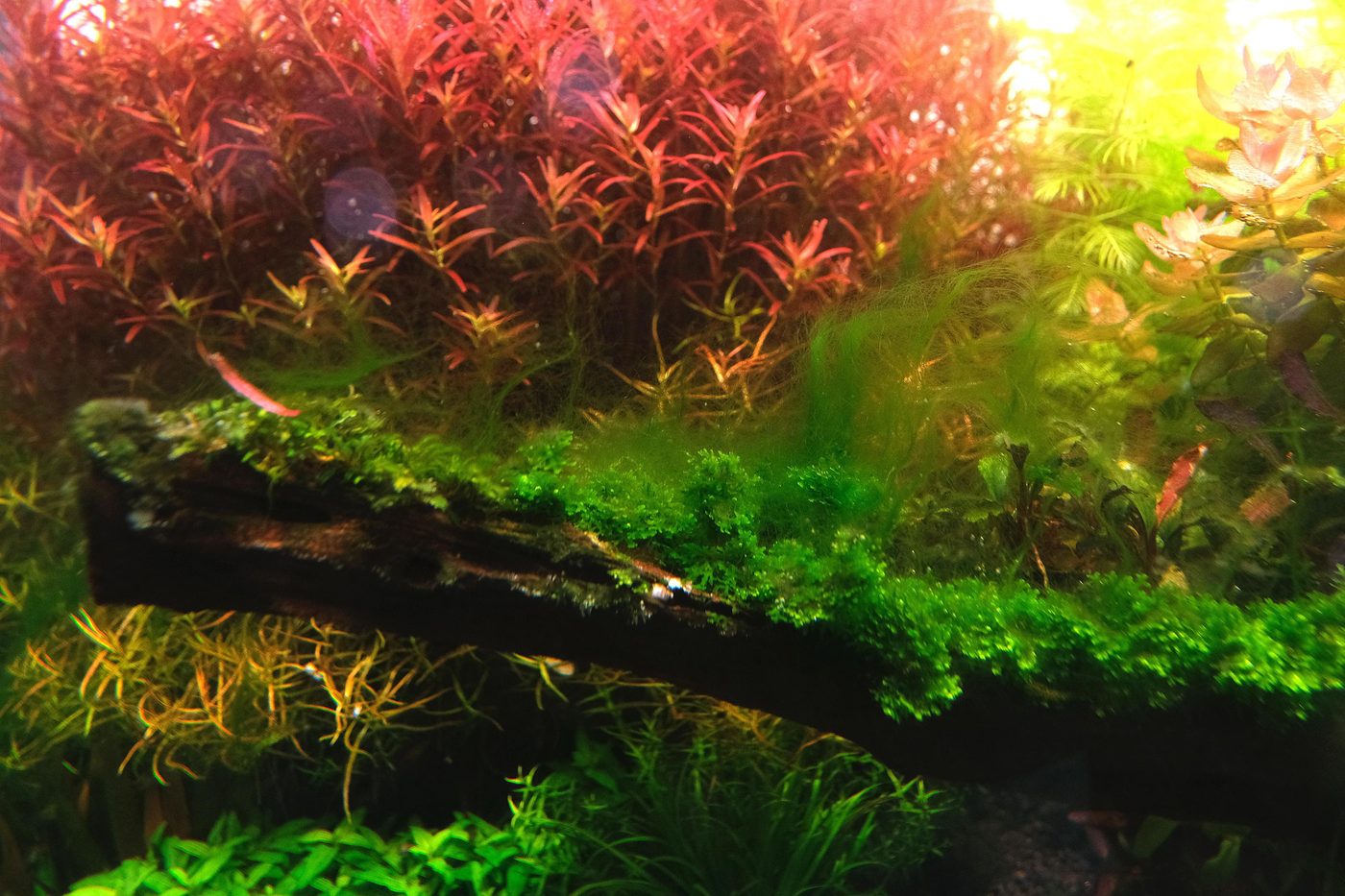
Bring a water sample and a fresh sample of the nuisance growth to Barrier Reef.
Barrier Reef has an in-store microscope, and our manager and resident aquatic biologist can examine nuisance growth microscopically when necessary.
Microscopy can be especially useful for distinguishing:
Dinoflagellates • Cyanobacteria • Diatoms • Other microscopic nuisance organisms
Clear photos showing how the growth appears inside the aquarium are also helpful.
FRESHWATER AQUARIUMS
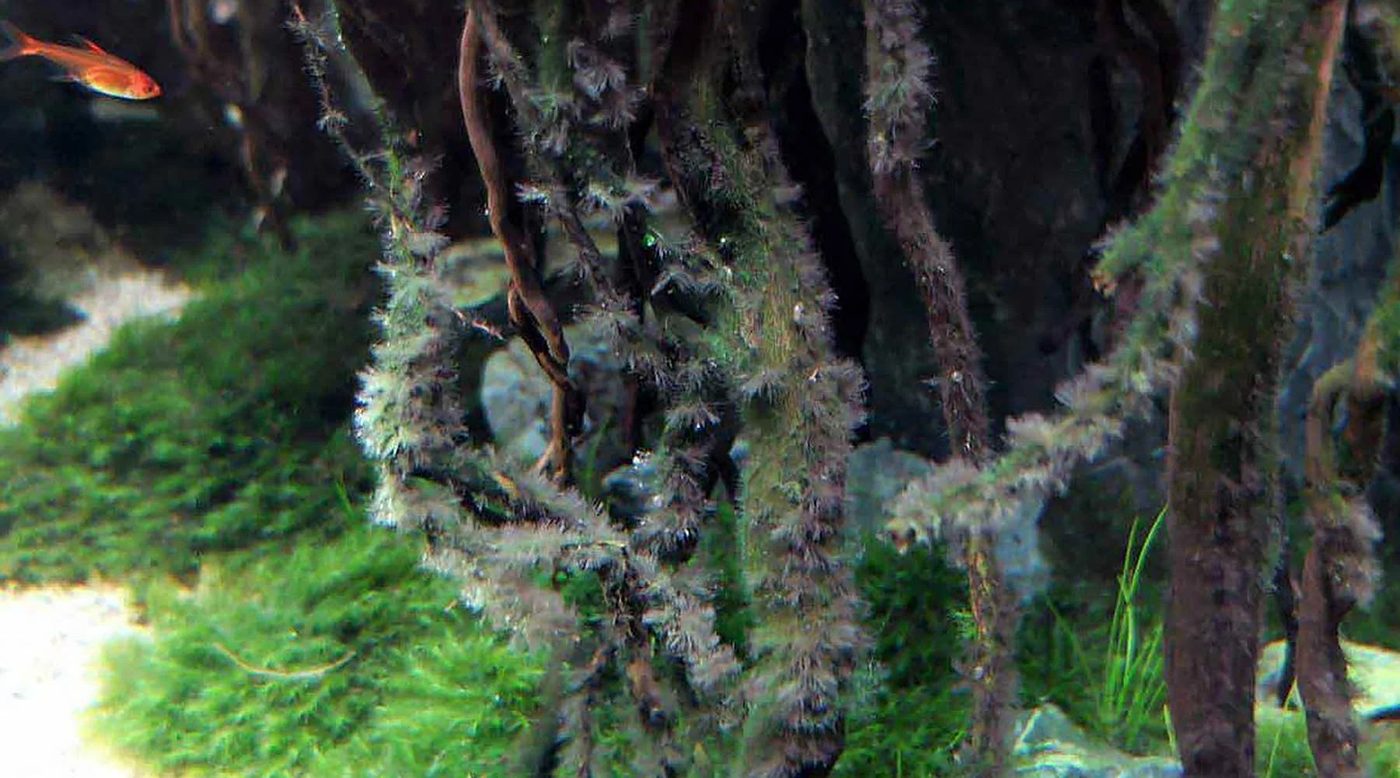
Image provided by 2hraquarist.com
Green Hair & Filamentous Algae
What It Looks Like
Green hair and filamentous algae form green threads, hairs, tufts, or tangled strands growing from plants, rocks, wood, substrate, decorations, or equipment.
Different species may appear as short fuzz, long strands, branching threads, or dense tangles.
What To Do
Manual removal is one of the best first steps.
A clean toothbrush can be used to wind up longer strands.
Trim heavily affected plant leaves and remove accumulated debris from the aquarium.
Review:
Lighting • Plant health • Fertilization • Feeding • Organic waste • CO₂ stability in injected aquariums
Healthy, actively growing plants provide valuable competition for available resources.
Appropriate algae-grazing animals may also help. Amano shrimp and true Siamese algae eaters consume some filamentous algae, but cleanup animals should complement good husbandry rather than replace it.
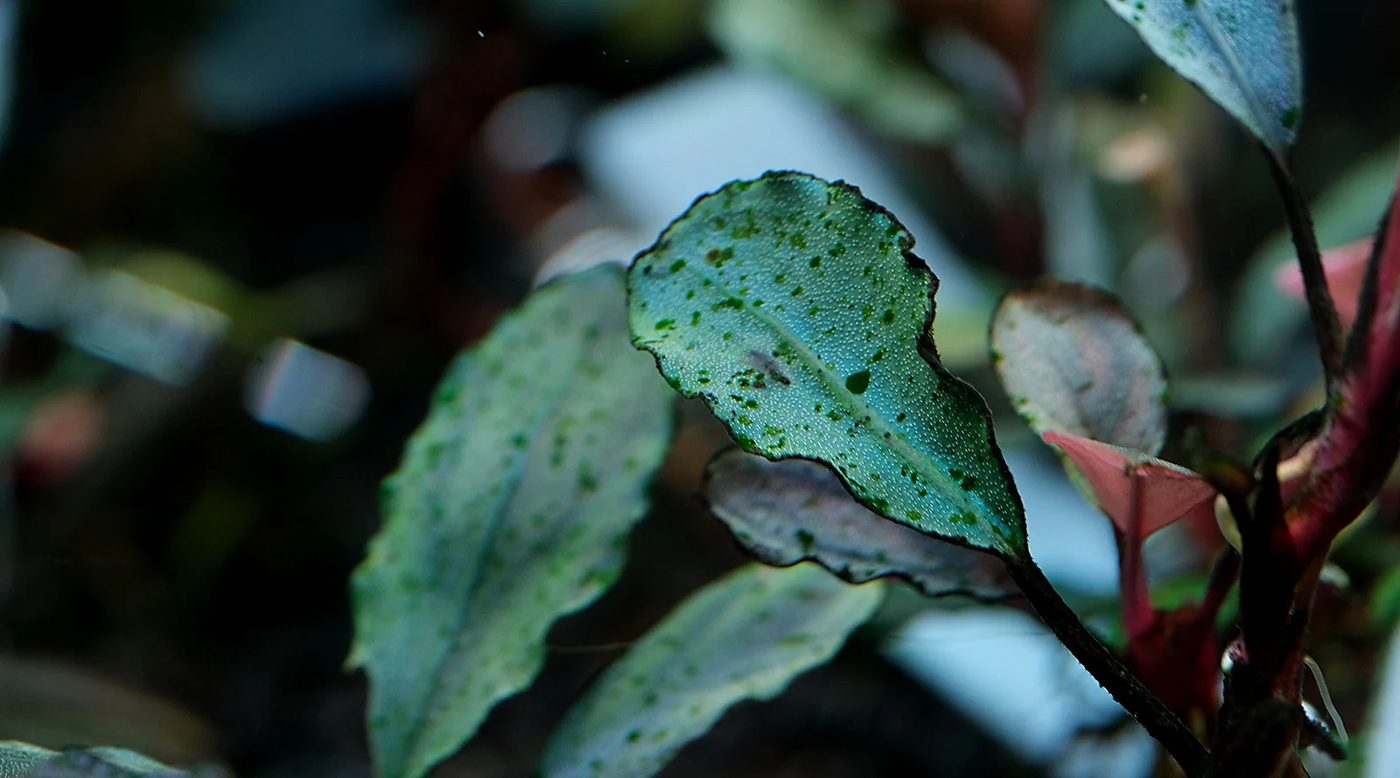
Image provided by 2hraquarist.com
Black Beard / Black Brush Algae
What It Looks Like
Black beard algae, often abbreviated BBA, forms short, dense tufts that may appear black, dark gray, reddish, or purple.
It commonly grows on:
Older plant leaves • Driftwood • Rocks • Filter outlets • Decorations • Equipment
Despite its dark appearance, black beard algae belongs to a group of red algae.
What To Do
Remove heavily affected leaves when practical.
Physically clean hardscape and equipment and remove accumulated organic debris.
Treat affected plants, equipment and hardscape with 3% Hydrogen Peroxide, Seachem Flourish Excel or API Fix or Fix Lite
In planted aquariums, pay particular attention to:
Plant health • CO₂ stability • Water circulation • Organic accumulation • Lighting intensity
Reducing excessive lighting while correcting the underlying issue. In low tech aquariums, BBA is most commonly assocaited with poor qater quality and build up or organic waste. In high tech systems, CO2 instability and poor plant management are the main contributors. Avoid assuming that one nutrient reading alone is responsible for a BBA outbreak.
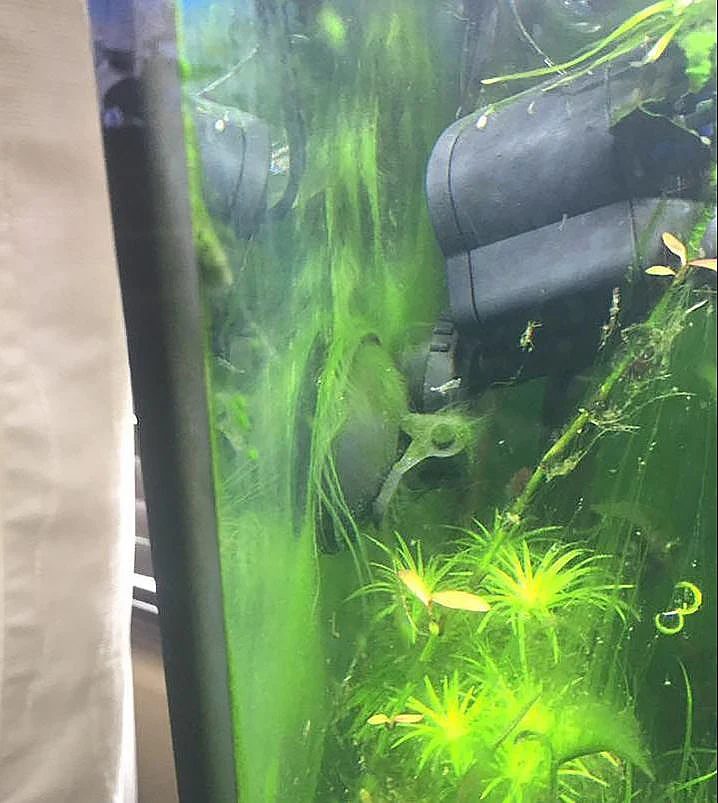
Image provided by 2hraquarist.com
Green Spot Algae
What It Looks Like
Green spot algae forms small, hard green dots on aquarium glass, decorations, and slow- growing plant leaves.
Unlike soft green film algae, it is difficult to wipe away.
What To Do
Remove it from glass using an aquarium-safe scraper.
Older heavily affected plant leaves may need to be trimmed.
Review lighting duration, intensity, and overall plant nutrition if growth becomes excessive.
GSA is often associated with poor water quality, ultra low phosphates and inconsistent maintenance. Consistent water changes will often help.
Algacides may be necessary in extreme outbreaks to soften and limit new GSA growth.
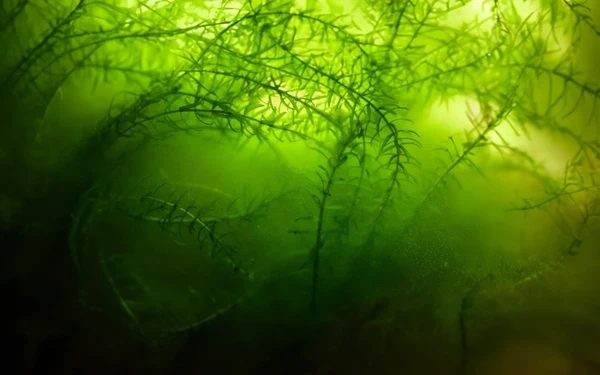
Image provided by 2hraquarist.com
Green Film / Green Dust Algae
What It Looks Like
Green film or green dust algae forms a soft green coating over aquarium glass and other surfaces.
Unlike green spot algae, it usually wipes away relatively easily.
What To Do
Clean the glass as needed and review:
Lighting • Plant health • Aquarium maturity • Nutrient balance
Healthy plant growth and a biologically mature aquarium often reduce recurring film algae.
- Build up dominant plant mass in the tank (70% + planted)
- Optimize CO2 levels (>30ppm)
- For mild to moderate cases, APT Fix or other algacides will work - up to 1ml per 10L of tank water, repeatable every 24 hours
- 3-5 days blackout for serious cases
- Lower water temperatures help significantly (<24 degrees celsius) Better oxygenation helps
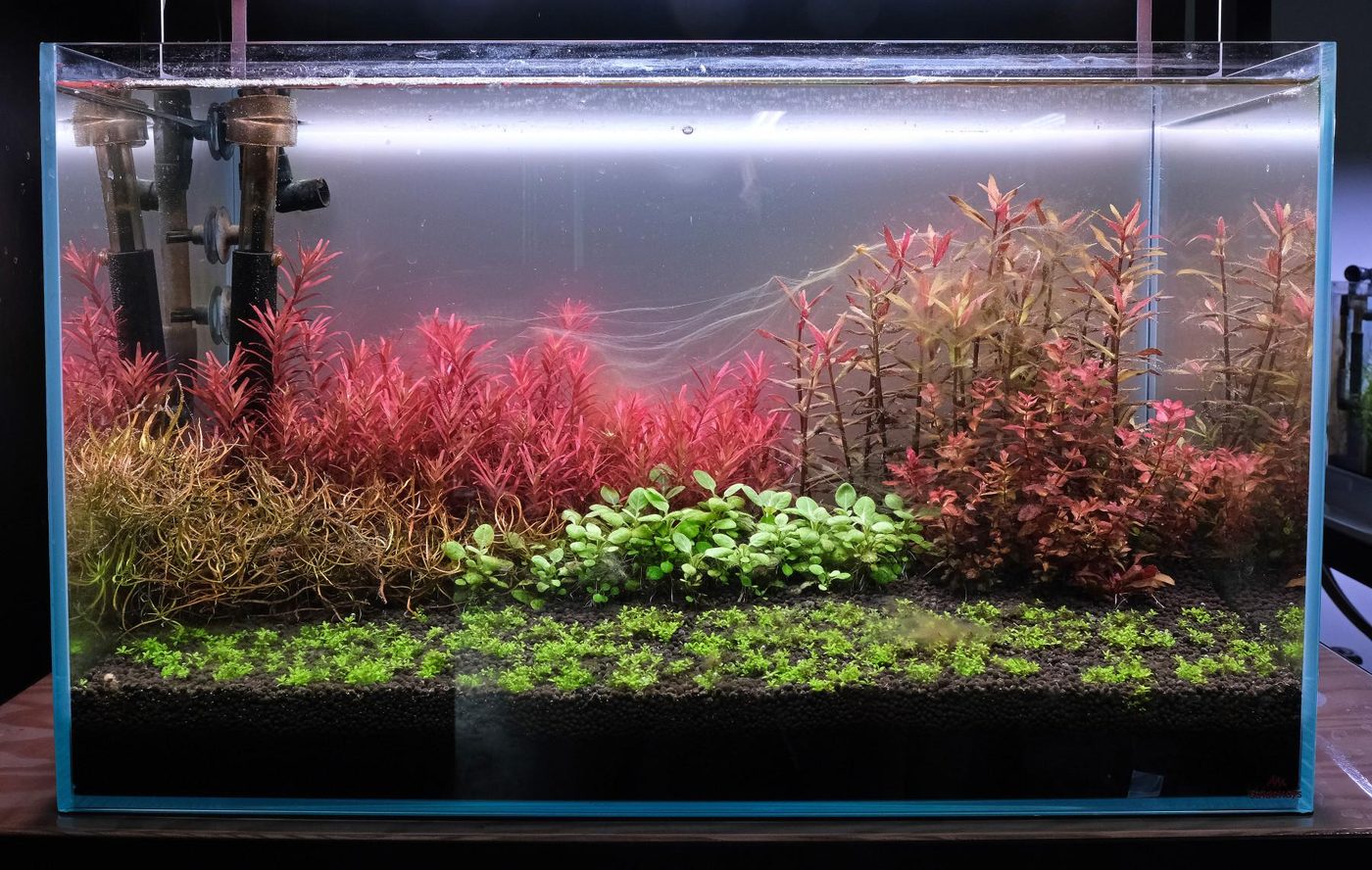
Image provided by buceplant.com
Green Water
What It Looks Like
The aquarium water itself becomes green and cloudy while surfaces may remain relatively clean.
Green water is caused by microscopic algae suspended throughout the water column.
What To Do
Check for and correct:
Excessive lighting • Direct sunlight • Overfeeding • Nutrient accumulation • Poor aquarium balance
Regular water changes and correcting the underlying cause are important.
Because the algae are suspended in the water column, a properly sized UV sterilizer can be particularly effective for clearing green water. Pro Tip: UV Sterilizers also aid in prevention of bacterial infections and ectoparasites.
Images provided by 2hraquarist.com
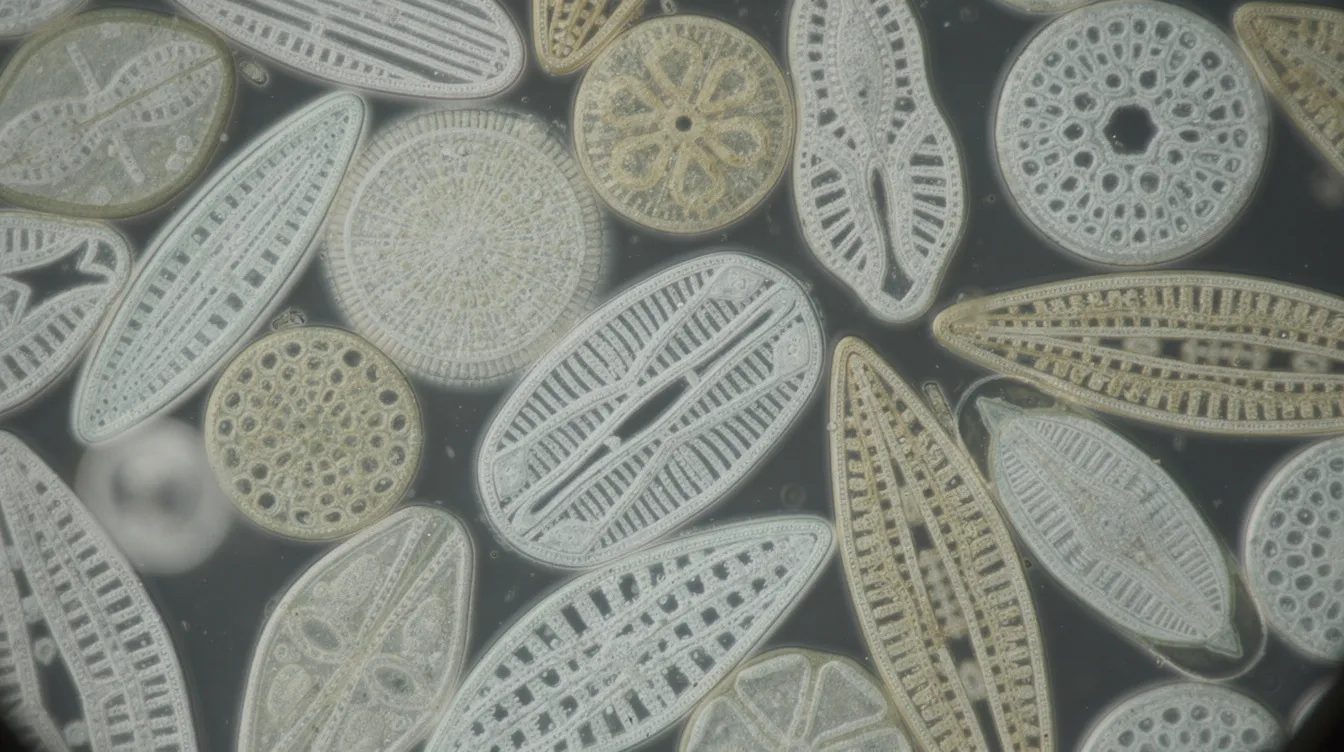
Freshwater Brown Diatoms
What They Look Like
Diatoms commonly appear as a soft:
Brown • Tan • Golden-brown dusty or filamentous coating on: Glass • Substrate • Plants • Rocks • Decorations
They generally wipe away easily.
Diatoms are microscopic algae with silica-containing cell walls and are particularly common in newer aquariums.
What To Do
In a newer aquarium, patience is often the best approach.
Wipe the glass, siphon affected surfaces during water changes, maintain appropriate filtration and lighting, and allow the aquarium to mature.
Avoid aggressively chemically treating a normal new-tank diatom bloom.
If significant diatom growth persists in a mature aquarium, source water and silicate input may be worth investigating.
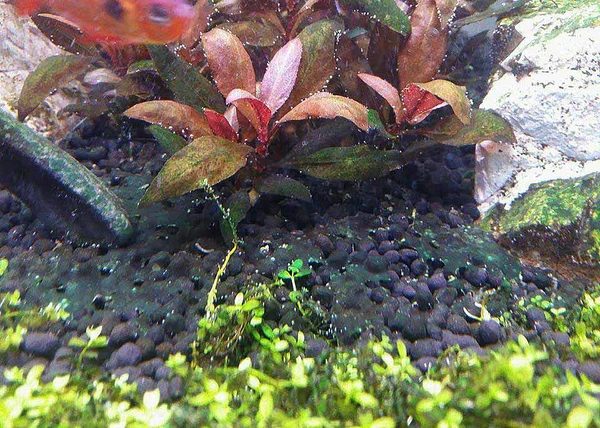
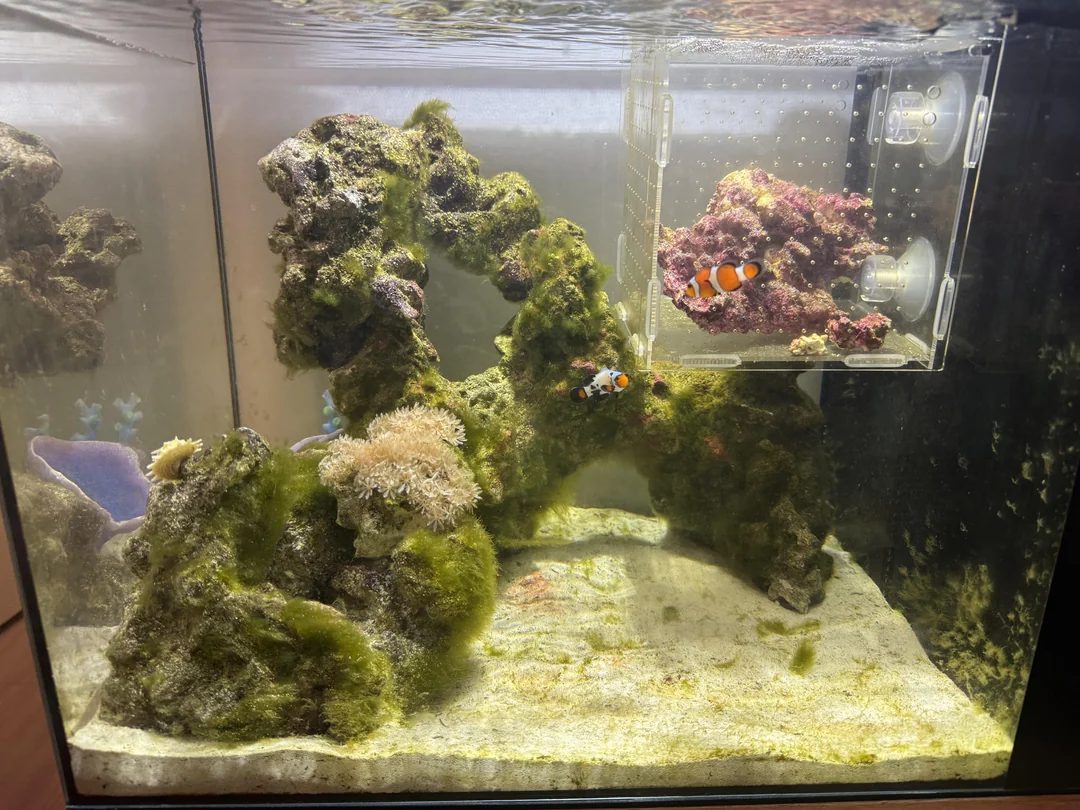
Image provided by 2hraquarist.com
Freshwater Cyanobacteria — “Blue-Green Algae”
Cyanobacteria is not a true algae.
What It Looks Like
Freshwater cyanobacteria often forms smooth, slimy mats or sheets.
Colors may include:
Blue-green • Dark green • Brown • Black
It may peel away from the substrate in sheets and can sometimes have a noticeable earthy or muddy odor.
Common Contributors
Accumulated organic waste • Poor circulation • Low-oxygen areas • Nutrient imbalance • Very low nitrate in some planted systems
What To Do
Siphon out as much of the mat as practical rather than breaking it apart and distributing it throughout the aquarium.
Improve circulation where necessary.
Remove accumulated detritus.
Review filtration, feeding, and nutrient balance.
Chemical treatments are available, but correcting the conditions that encouraged cyanobacteria should remain the priority.
SALTWATER & REEF AQUARIUMS
Green Hair Algae
What It Looks Like
Marine green hair algae forms green filamentous growth ranging from short fuzz to long strands.
It commonly grows on:
Rockwork • Pumps • Overflows • Frag plugs • Coral bases • Other hard surfaces
Common Contributors
Available nutrients, accumulated detritus, excessive lighting, immature biological competition, and insufficient grazing can all contribute.
An aquarium covered in algae can sometimes produce deceptively low nitrate or phosphate test results because the algae itself is actively absorbing nutrients.
What To Do
Manually remove as much as possible.
Siphon loosened material from the aquarium.
Remove trapped detritus and review feeding.
Maintain appropriate nitrate and phosphate levels rather than automatically attempting to eliminate both nutrients.
Appropriate nutrient export may include:
Water changes • Protein skimming • Mechanical filtration • Refugia • Other appropriate filtration methods
A properly selected cleanup crew can also be very helpful.
Do not assume nitrate and phosphate should always be zero.
Turf Algae
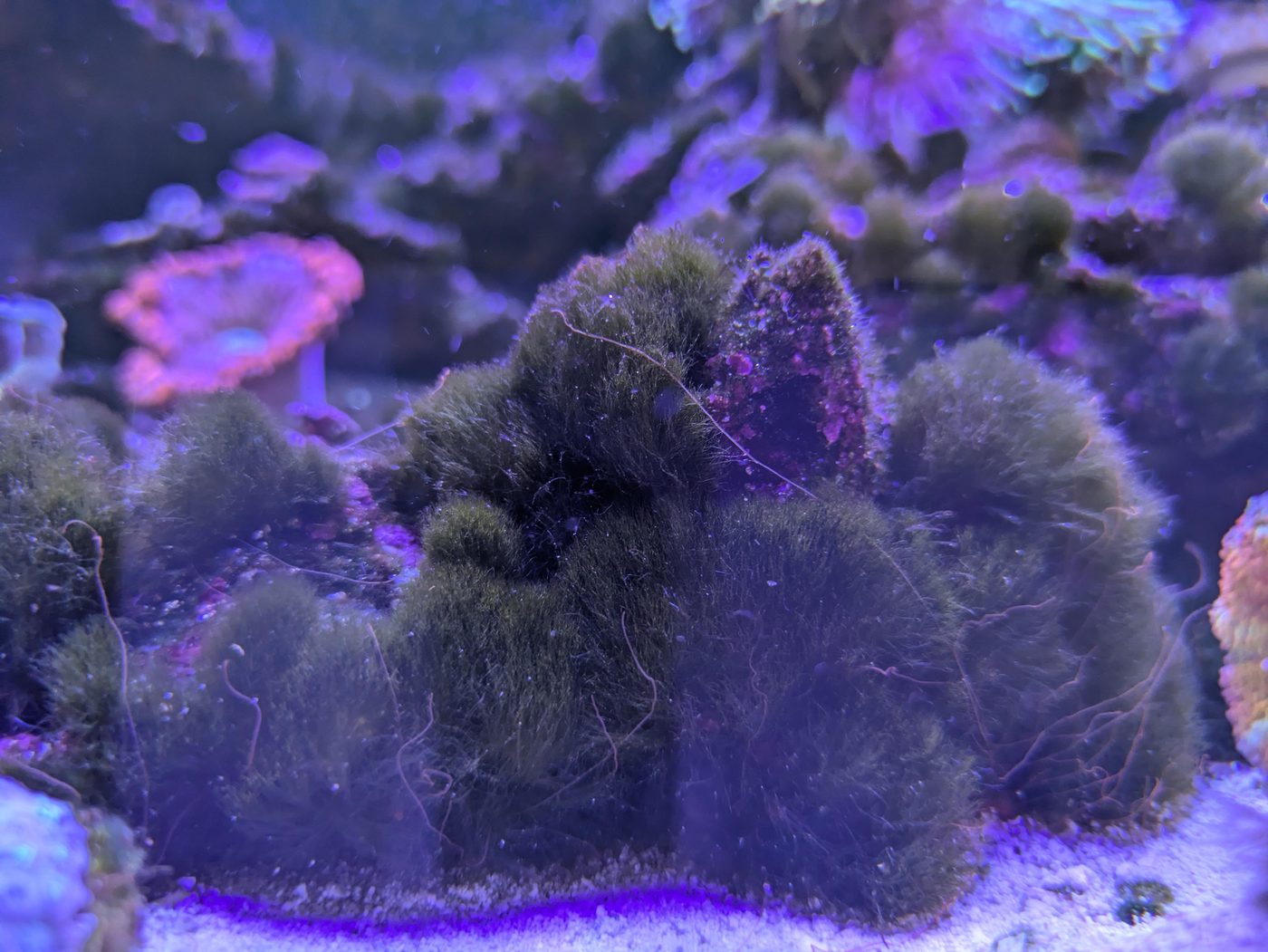
What It Looks Like
Turf algae forms short, coarse, dense mats that remain tightly attached to rock. Turf Algae can refer to several species of macro algae that share similar characteristics.
It is generally tougher and more difficult to pull away than ordinary hair algae.
What To Do
Physical removal is important.
Scrub removable rock outside the aquarium when appropriate and siphon loosened material.
Reduce accumulated detritus and maintain appropriate nutrient levels.
Compatible herbivorous grazers may help.
Established turf algae often requires repeated removal rather than a single treatment.
Bryopsis
What It Looks Like
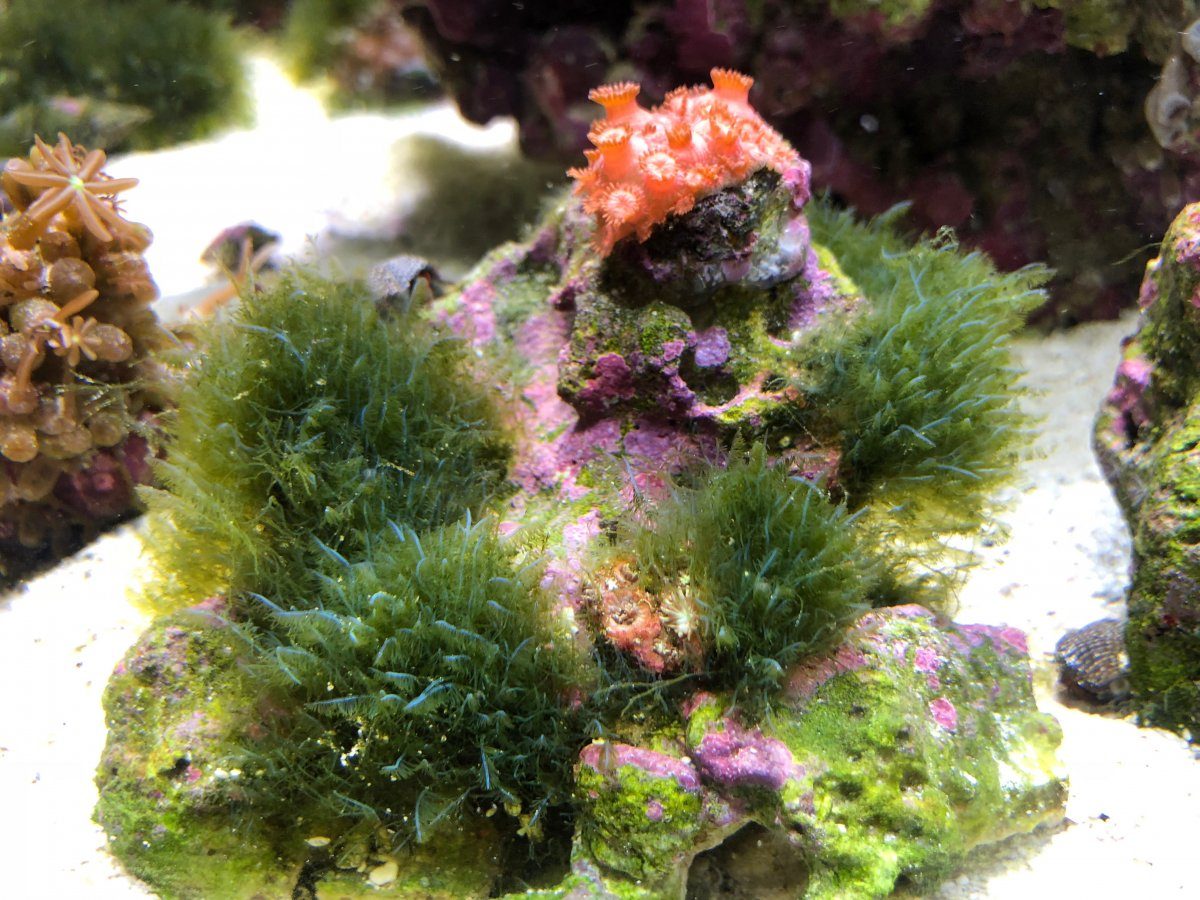
Bryopsis is a green filamentous macroalga with characteristic feathery or fern-like branches.
It can easily be confused with ordinary green hair algae.
What To Do
Carefully remove affected material when practical while minimizing fragmentation.
Avoid scattering pieces throughout the aquarium.
Correct nutrient and maintenance issues, but understand that established Bryopsis can sometimes persist even after general aquarium conditions improve.
Specialized treatments are used within the reef hobby, but Barrier Reef recommends confirming the identification before beginning treatment.
Bring a sample to Barrier Reef if you are uncertain.
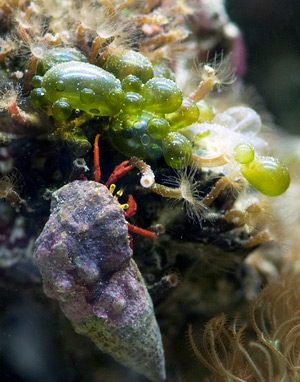
Image provided by Jeff Kurtz.
Bubble Algae
What It Looks Like
Bubble algae generally forms smooth green (Valonia sp.) or brown (Colpomenia sp.) spherical or oval structures attached to:
Rockwork • Coral skeletons • Frag plugs • Other hard surfaces
Individual bubbles can vary significantly in size and shape.
What To Do
Attentive and aggressive Physical removal is generally the first approach.
Remove the entire structure and attachment when possible.
When practical, removable rock or frag plugs can be cleaned outside the display aquarium.
Regularly inspect new coral frags and rock before adding them to the display.
Compatible grazers such as Emerald or Ruby Crabs (Mithraculus sculptus) and Pitho Crabs (Pitho mirabilis) as well as certain rabbitfish species may help, although results vary.
MARINE CYANOBACTERIA
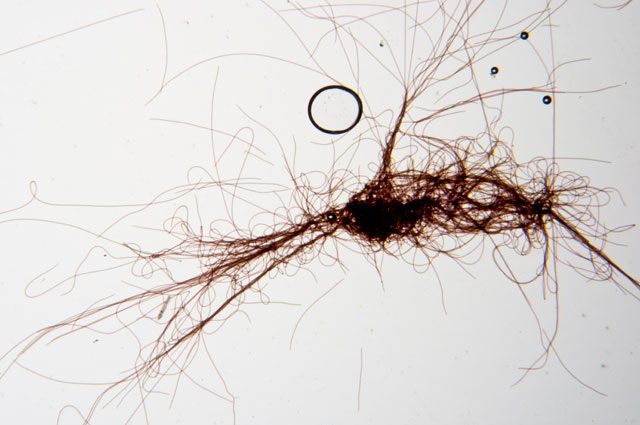
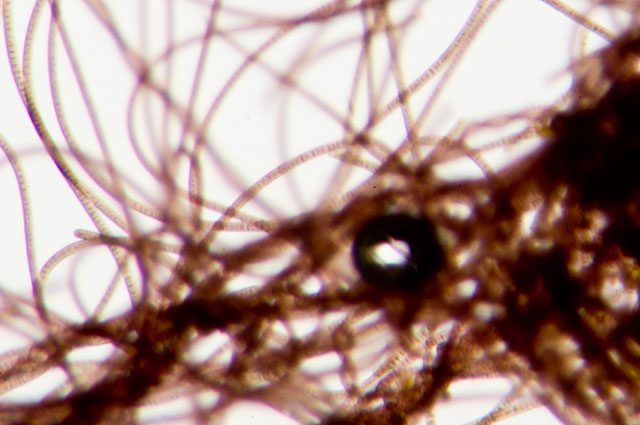
Oscillatoria 10X magnification
Oscillatoria 100X magnification
Images courtesy of Dr. Mendez (AlgaeID.com)
Image provided by SaltwaterAquarium.com
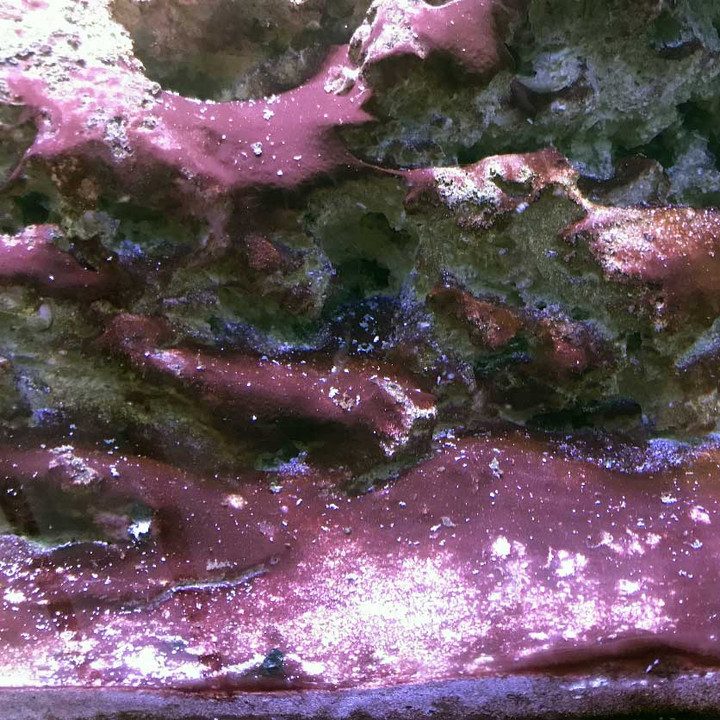
Cyanobacteria is often called “red slime algae,” but it is actually bacteria rather than true algae.
Various sp of Cyanobacteria exist in marine systems and can be blue/green, black or even brown and bubbly like Calothrix sp.
What It Looks Like
Marine cyanobacteria commonly forms slimy sheets or mats over sand and rock.
Colors may include:
Red • Burgundy • Purple • Brown • Dark green • Nearly black
Gas bubbles are commonly trapped within or underneath the mat.
The material often peels or siphons away in sheets.
What To Do
Siphon the cyanobacteria out rather than simply stirring it into the aquarium.
Remove accumulated detritus.
Improve water movement in affected areas when necessary.
Review:
Feeding • Filtration • Nutrient balance • Organic accumulation • Water movement
Chemical cyanobacteria treatments can sometimes be effective, but they should not replace correcting the underlying conditions.
When a treatment causes substantial microbial die-off, maintain strong oxygenation and follow product instructions carefully.
MARINE DIATOMS
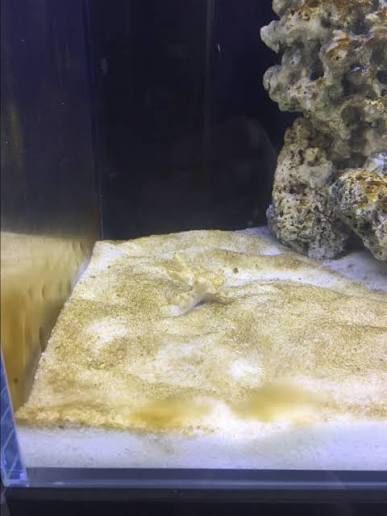
What They Look Like
Marine diatoms generally appear as a fine:
Golden-brown • Tan • Rust-colored dusting across: Sand • Glass • Rock • Equipment
They wipe away easily and generally do not produce the long mucus-like strings commonly associated with some dinoflagellate blooms.
What They Usually Mean
Diatoms are extremely common during the early stages of a new marine aquarium.
Available silicate contributes to their silica-based cell walls, and blooms often occur while a young aquarium's biological community is developing.
What To Do
In a new aquarium:
Be patient.
Continue routine maintenance and allow the system to mature.
Clean the glass and siphon affected substrate as needed.
An appropriate cleanup crew can help once the aquarium is ready.
If heavy diatom growth persists in a mature reef aquarium, evaluate source water and RO/DI filtration.
A normal new-tank diatom bloom generally does not require chemical treatment.
DINOFLAGELLATES — “DINOS”
Dinoflagellates are not ordinary nuisance algae.
Correct identification is especially important because different dinoflagellate genera can behave differently and respond differently to treatment.
They are frequently mistaken for diatoms or cyanobacteria.
What They May Look Like
Depending on the organism, a bloom may appear as:
Brown or golden mucus • Strings • Web-like growth • Dusty coatings • Bubbles trapped in strands
Some become dramatically more visible during the light cycle and diminish overnight.
Appearance alone cannot reliably identify every dinoflagellate.
Microscope Identification
Barrier Reef strongly recommends microscopic examination when a persistent dinoflagellate bloom is suspected.
Our manager and resident aquatic biologist can examine a fresh sample using Barrier Reef's microscope.
Cell shape, size, movement, and behavior can help distinguish common reef aquarium dinoflagellates.
Common groups include:
Ostreopsis • Amphidinium • Prorocentrum • Coolia
Different genera may require different management strategies.
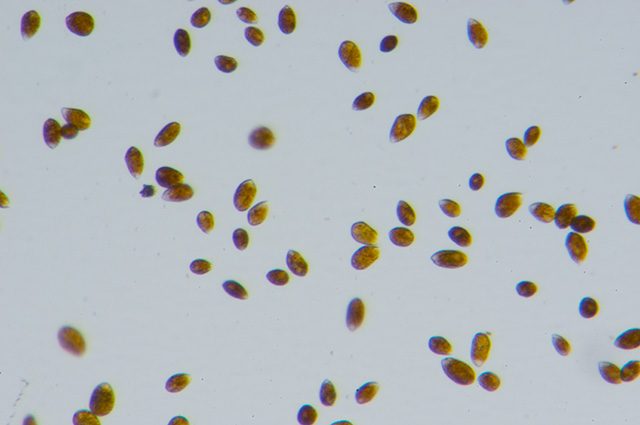
Ostreopsis sp. at 100X magnification
Images courtesy of Dr. Mendez (AlgaeID.com)
Ostreopsis
Microscope Appearance
Ostreopsis has a distinctive shape and characteristic movement.
Under magnification, cells may display a recognizable tethered or spinning motion around an attachment point.
Observing movement can therefore be useful in addition to cell shape.
Important Safety Warning
Some Ostreopsis species can produce potent palytoxin-related compounds. These can bioaccumulate in many invertebrates and fish causing death and can be harmful to humans.
Use additional caution with a suspected bloom.
Avoid: Creating aerosols • Pressure washing contaminated material • Careless handling of concentrated growth
When removing suspected toxic dinoflagellates:
- Maintain good ventilation.
- Wear appropriate protective equipment.
- Keep children and pets away from removed material.
- Wash thoroughly afterward.
- Consider fresh activated carbon as part of aquarium management.
- Avoid aerosol-producing cleaning methods.
If livestock is distressed during a suspected dinoflagellate bloom, contact Barrier Reef before beginning aggressive treatment.
Amphidinium
Real Microscope Photos + Videos
AlgaeID — Amphidinium: https://algaeid.com/identification/
Microscope Appearance
Amphidinium is generally smaller than many Ostreopsis cells.
It frequently moves smoothly across surfaces rather than displaying the more characteristic tethered spinning associated with Ostreopsis.
Many Amphidinium populations remain closely associated with sand and other surfaces.
Why Identification Matters
Dinoflagellates that remain attached to surfaces may respond differently to treatment than organisms that spend significant time suspended in the water column.
This can influence the usefulness of treatments such as UV sterilization.
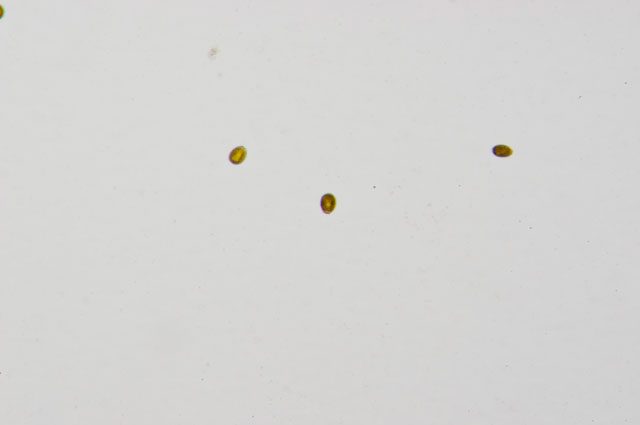
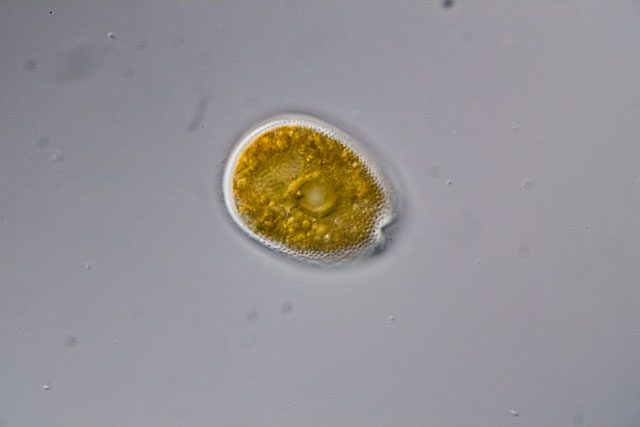
Prorocentrum hoffmanianum 60X magnification
Prorocentrum hoffmanianum 630X magnification
Images courtesy of Dr. Mendez (AlgaeID.com)
Prorocentrum
Microscope Appearance
Prorocentrum can resemble other dinoflagellates without magnification.
Cell size, shape, and movement provide useful diagnostic clues.
Do not choose a dinoflagellate treatment solely from the appearance of the aquarium.
Managing Dinoflagellate Blooms
There is no single treatment that works equally well for every dinoflagellate.
Depending on the organism and aquarium, management may include:
- Confirming identification microscopically.
- Avoiding zero nitrate and zero phosphate.
- Maintaining measurable and appropriate nutrient levels.
- Siphoning visible growth.
- Removing accumulated detritus.
- Encouraging biological diversity and competition.
- Reviewing the lighting schedule.
- Using UV sterilization when the identified organism spends significant time in the water column.
- Using fresh activated carbon when toxin-producing species are suspected.
- Improving overall aquarium stability.
Dinoflagellate blooms are sometimes associated with very low or undetectable nitrate and phosphate, particularly in relatively young or biologically unstable reef systems.
This is one reason that aggressively stripping nutrients from every aquarium with a brown coating can sometimes make the situation worse.
DIATOMS VS. CYANOBACTERIA VS. DINOFLAGELLATES
These organisms are commonly confused because all three can appear brown, reddish, or slimy from a distance.
Diatoms
- Typical appearance
- Fine brown or golden dust
- Texture
- Dusty
- Bubbles
- Usually minimal
- Removal
- Wipes away easily
- Common in new aquariums
- Very common
- Typical first response
- Routine maintenance and patience
Cyanobacteria
- Typical appearance
- Red, green, brown, purple, or dark slimy sheets Texture: Slick or slimy
- Bubbles
- Common
- Removal
- Often peels or siphons away in mats
- Typical first response
- Siphon and correct underlying conditions
Dinoflagellates
- Typical appearance
- Brown or golden mucus, strings, dust, or web-like material depending on genus
- Texture
- Often mucus-like or stringy
- Bubbles
- Often present
- Removal
- Slime, strings, coatings, or surface-associated growth
- Typical first response
- Identify the organism before selecting treatment
BARRIER REEF MICROSCOPE IDENTIFICATION
Not Sure What You're Looking At? Don't Guess. Many nuisance organisms look remarkably similar to the naked eye.
Treating a misidentified organism can waste time, stress livestock, or potentially make the problem worse.
Barrier Reef has an in-store microscope available for nuisance-organism identification.
For the best evaluation, bring:
- A fresh sample of the nuisance growth
- A sample of your aquarium water
- Clear photographs showing where and how the growth appears in the aquarium, when possible
Our manager and resident aquatic biologist can examine the sample microscopically and help distinguish organisms such as:
Dinoflagellates • Cyanobacteria • Diatoms • Other nuisance microorganisms
With dinoflagellates, cell shape and movement can provide information that a normal aquarium photograph cannot.
Video of organisms moving under the microscope can also be particularly useful.
REMOVAL & DISPOSAL
When manually removing nuisance algae, cyanobacteria, diatoms, or dinoflagellates:
Remove the material from the aquarium rather than simply breaking it apart and allowing it to circulate through the system.
Siphoning is often preferable for mats, slime, loose coatings, and dinoflagellate growth.
Discard removed organisms rather than transferring them into another aquarium.
Never Release Aquarium Organisms Into the Environment
Do not dump:
Aquarium water • Algae • Cyanobacteria • Plants • Rock • Substrate • Livestock into:
Canals • Lakes • Ponds • Rivers • Storm drains • Natural waterways
Unwanted biological material should be securely contained and disposed of with household waste where appropriate.
Clean reusable aquarium tools before moving them between aquariums, particularly when dealing with an unidentified nuisance organism.
Use additional care when handling suspected toxin-producing dinoflagellates.
TREAT THE CAUSE, NOT JUST THE GROWTH
A nuisance outbreak usually tells us something about the aquarium.
Before immediately reaching for an algaecide, review:
Lighting • Nutrients • Feeding • Detritus • Water movement • Filtration • Source water • Stocking • Plant health • Biological maturity
Remember that zero nitrate and zero phosphate are not automatically signs of a healthy aquarium, particularly in reef systems.
The goal is not a sterile aquarium.
A healthy aquarium naturally contains algae, bacteria, microorganisms, and many other forms of life.
The goal is a stable and biologically balanced aquarium in which nuisance organisms do not dominate.
Questions about your own tank? Bring us a water sample, a photo, or the animal.